
Skip to content

Open 24/7Upfront pricing

Water heaters in Austin

Water heater repair and tankless replacement in Austin

No hot water, a rumbling tank or a puddle in the garage? Call (512) 555-0194 and we will find out if it is a repair or time for a new unit.

(512) 555-0194 Call now
  • Tank and tankless units
  • Repair or replace, explained plainly
  • Written quote before work starts
Request a plumber
How soon do you need help?

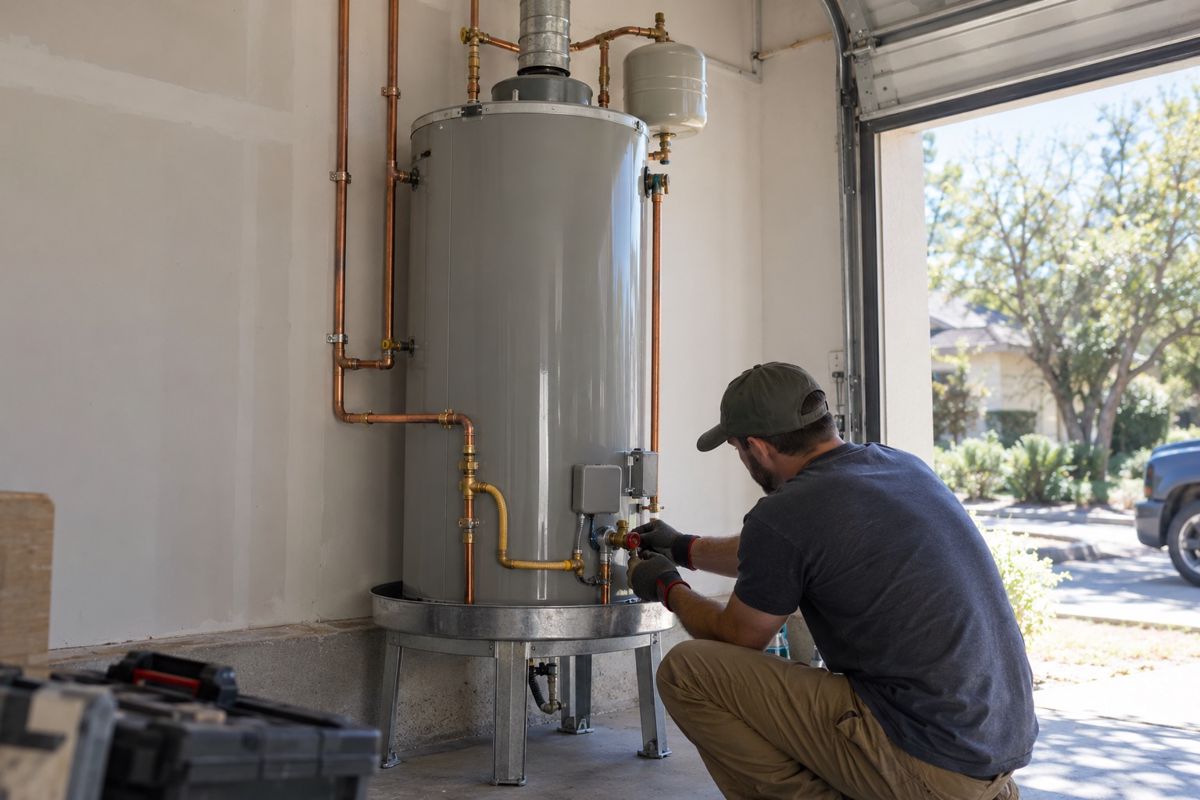
New tank water heater on a raised stand in a garage

Should I repair or replace my water heater?

This is the first question most homeowners ask, and the honest answer depends on the age of the heater and what is wrong with it. Tank heaters often last roughly ten to fifteen years, and Austin's hard water can shorten that when sediment is not flushed out.

A repair makes sense when the tank is sound and the failed part is small, such as a thermostat, a heating element, a gas control or a pressure relief valve. Replacement usually makes more sense when the tank itself is leaking, when the unit is near the end of its life, or when repairs keep adding up.

Water that is leaking from the tank body cannot be repaired. If you see moisture at the base, turn off the power or gas and close the cold water valve. For after-hours leaks, our emergency plumbing page explains the first steps.

What are the signs of a failing water heater?

Water heaters rarely fail without warning. Watch for these signs and call before a small problem becomes a flooded closet or garage.

  • Not enough hot water. Showers turn cold sooner than they used to.
  • Rumbling or popping. Scale and sediment trapped at the bottom of the tank can make it noisy and wear it out faster.
  • Rusty or cloudy hot water. It can mean corrosion inside the tank.
  • Moisture around the base. Check the floor and the drain pan.
  • Pilot light that keeps going out on a gas unit.
  • A tripped breaker on an electric unit.

Many Austin water heaters sit in garages or attics. A slow leak in an attic can stain a ceiling long before anyone sees it, so a quick look at the pan and the ceiling below is worth doing once in a while.

Is a tankless water heater worth it in Austin?

Tankless units heat water as you use it, so they do not run out the way a tank can, and they take up far less space. They can be a good fit for a larger household or a tight closet.

Austin's mild incoming water temperature is easier on a tankless unit than in colder cities, because the heater has less work to do. The catch is hard water. Scale builds up inside the heat exchanger, and manufacturers generally recommend regular flushing. Skip the maintenance and the unit loses efficiency.

Things to check before switching

  • Gas line size and venting for a gas unit
  • Electrical capacity for an electric unit
  • Where the unit will mount and how it will drain
  • Whether a water softener or scale filter is worth adding

A good plumber will compare tank and tankless for your house instead of pushing one option.

We do not post prices because the same job can look very different from one house to the next. These are the main factors.

  • Repair or replacement. A part swap is a smaller job than a full unit.
  • Tank size and type. Gas, electric, tank and tankless all differ in equipment cost.
  • Location. A heater in an attic or tight closet takes more effort to remove and install than one in an open garage.
  • Code updates. Venting, a raised stand in a garage, an expansion tank, a drain pan or relief valve piping may need to be brought up to current standards.
  • Permit. Austin generally expects a plumbing permit for water heater replacement. Ask who will handle it.
  • Haul-away of the old unit.

You will get the full picture in a written quote. If the leak has already reached the pipes, a nearby slab leak could be worth ruling out.

How long does it take and what happens on the day?

A straightforward tank replacement is often finished in part of a day, while tankless conversions can take longer if gas lines, venting or wiring change. Repairs vary depending on parts.

On the day, we confirm the diagnosis, shut off power or gas and water, drain the tank, and remove the old unit. We then set the new one, connect water, gas or electric, vent and relief piping, and test it. You will have a short walkthrough of the shutoff valve and the temperature setting.

Before we start, ask about the permit, the warranty from the manufacturer, and what happens to the old unit. Preparing the space helps: clear a path to the heater and move stored items out of the way.

Back to our Austin plumber home page for other services.

Open 24/7
Upfront pricing
Clear communication
Local plumbers
How soon do you need help?

Questions about emergency plumber in Austin

How long does a water heater last?

Tank water heaters commonly last around ten to fifteen years, though hard water, missed flushing and heavy use can shorten that. Tankless units often last longer if they are descaled on schedule. Age matters, but condition matters more. A plumber can look at the tank and tell you where yours stands.

Why does my water heater make a rumbling noise?

The noise is usually sediment and scale at the bottom of the tank. Water trapped under that layer boils and pops. Austin has hard water, so this is common. A flush can sometimes help on a younger unit. On an older tank, heavy noise may mean it is close to the end.

Can I replace a water heater myself in Texas?

Rules differ for homeowners and contractors, and gas, venting and electrical connections carry real risk. Austin generally expects a permit for replacement. A mistake with gas or relief piping can be dangerous. Most owners hire a licensed plumber, and you should ask that plumber who is pulling the permit.

Do I need an expansion tank?

It depends on your plumbing setup. Homes with a pressure reducing valve or check valve can build pressure when water heats and expands. An expansion tank gives that water somewhere to go. Your plumber can check your static pressure and tell you whether one is needed.

What should I do if my water heater is leaking?

Turn off the power or gas, close the cold water valve above the heater, and open a hot tap to ease pressure. Catch or mop up the water. If the leak comes from the tank itself, it needs replacing. If it is a fitting or valve, a repair may do. Call us for help.

How it works

  1. Call or tap for help

    Tell us what is wrong. We answer around the clock.

  2. Plumber dispatched

    The nearest plumber heads your way with a stocked van.

  3. Fixed with a written price

    You approve the price before any work starts.

Ready when you are

Call now or request a quote online.

(512) 555-0194
Takes about 30 seconds. Request a plumber